Ad disclosure: This is a collaborative post.
A neutral nursery in 2026 cannot is not simply about the absence of color; rather, it should be built around a flexible foundation that can be easily adapted to the family’s requirements. Parents prefer buying durable furniture and decorations that will last for several years without looking too childish. With such a method, you can design a stylish room without being dependent on fashion trends.
Why Neutral Nursery Design Is Still a Top Choice in 2026
Neutral nurseries will allow you to focus on elements like proportions, lighting, and textures in the room. Neutral hues will serve as a backdrop for furniture, fabrics, and details. Selections for this design can be viewed at https://www.zayko.net/, which presents items that are easy to integrate into a restrained palette.
Neutral colors can make a room feel more visually predictable and less stimulating. Milky, sand, oatmeal, warm white, or even muted olive will not produce any visual noise. The use of neutral baby nursery décor becomes especially important for those rooms where the kid not only sleeps, but also spends time with parents, plays, and learns to concentrate step by step.
One more factor in the popularity of neutral nurseries is their adaptability. It may be used in any area, budget, and style – from a city flat to a countryside cottage.

The Rise of Warm and Textured Neutrals in 2026
Cool gray gives way to more complex warm tones. Cream, caramel, linen color, clay, mushroom beige, and soft terracotta accents are on trend. These neutral nursery ideas go beyond plain white walls, especially when paired with matte surfaces, wood, ceramics, or fabrics with visible texture.
Textiles become the main tool for creating volume. Linen curtains, cotton sheets, wool carpets, and boucle throws can come in handy if you wish to alter the ambiance of your room without making any changes. Interior design in neutral colors for children’s rooms doesn’t necessarily have to be monotone; checkered, striped, and botanical prints can add some dynamism to the picture.
To keep the room from looking flat, use at least three different textures in your room. A practical approach to choosing details can be as follows:
- choose one basic shade for the walls and large furniture;
- add wood or rattan for a warmer visual balance;
- use textiles of different densities – from thin linen to soft boucle;
- leave one or two contrasting accents in natural tones;
- don’t fill every surface with decor.
Bringing Nature Indoors: Eco-Friendly and Handcrafted Elements
Natural materials are important in 2026, not only because of their appearance. Parents pay greater attention to the source of objects, their durability, and reusability. Wooden shelves, frames, hangers, storage boxes, and wicker baskets are practical nursery accessories, which remain useful after babies outgrow their cribs.
Handcrafted work adds individuality to the space. Handmade baby nursery decor can include textile pendants, wall figures, embroidered panels, or wooden toys. Such unique nursery accessories often have a noticeable texture and subtle differences not found in mass-produced products.
Creating Atmosphere with Functional and Gentle Lighting
Lighting in a neutral nursery should be multi-level. The main light is needed for child care, and the local light is for evening procedures. Textile wall night lights, lamps with matte shades, and small light objects help to softly illuminate the room without sharp contrast.
Cute nursery accessories can be functional: for example, a wall lamp in the shape of a cloud, animal, or moon also works as a decorative object. It is important to install such elements out of the child’s reach and choose models with reliable fastening and muted light. This supports a comfortable evening routine without unnecessary strain on the eyes.
Personalization in Neutral Spaces: Adding a Meaningful Touch
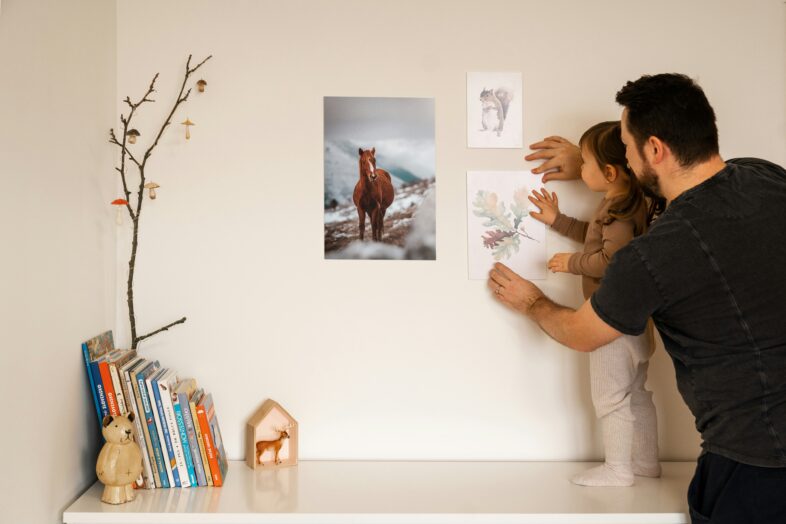
Personalization makes a discreet interior less impersonal. It can be the child’s name on a textile flag, the date of birth in a frame, a family photo or a small illustration created to order. Neutral nursery design does not need many personal items that represent your personality; one would suffice for you to bring your own history into the room.
A neutral nursery is easy to update over time, the foundation remains simple while the elements are changed slowly. That is why a neutral approach in 2026 is valued not for its universality as an abstract idea, but for the opportunity to equip a living space that changes with the child.