
Ad disclosure: We were provided with press tickets for the purpose of this post.
(3 stars)
Widely regarded as one of his finest novels, John le Carré’s The Spy Who Came In From The Cold helped define the espionage genre with its gritty storyline and exploration of the morally ambiguous world of Cold War intelligence agencies. There are no glamorous shaken martinis or immaculate tuxedos here, nor any guarantee of a happy ending for its weary spy protagonist.
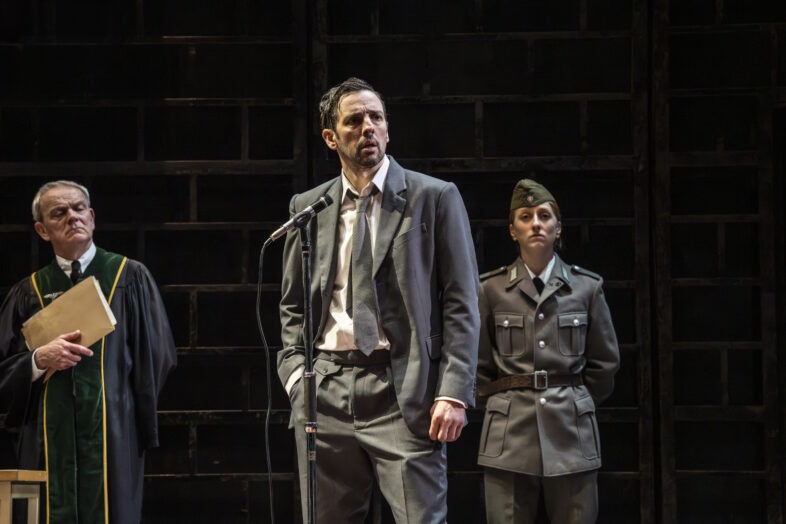
Last night James and I went to the opening night of the Birmingham stop on the UK tour, with The Spy Who Came In From The Cold becoming the first of John le Carré’s novels to be adapted for the stage. Adapted by David Eldridge and directed by Jeremy Herrin, this production is a bleak and atmospheric psychological thriller with a complex plot and an excellent cast.
Set between Berlin and London while the Berlin Wall divided the city in two, the play introduces us to British intelligence “Circus” agent Alec Leamas. Shortly afterwards, his final Berlin agent, Karl Riemeck, is killed. Burnt out and increasingly disillusioned, Leamas returns to London, where he reluctantly accepts one final mission involving East German intelligence. What initially appears to be a straightforward operation soon becomes something far more complex, as unseen figures manipulate events to achieve the outcome they desire.
This complex play explores how morals were seemingly tossed aside for “the greater good” by both sides of the Cold War, and how people could become pawns on a chessboard of deceit. Leamas meets idealistic librarian Liz Gold, and their emotional connection brings some softness to the story. It also demonstrates how love can become a weakness to be exploited when nothing is out of bounds in the pursuit of defeating an enemy.

The storyline is undeniably complex and, at times, difficult to follow. The brisk pace makes it easy to miss important plot points if your attention drifts for even a moment. There’s a huge amount of story packed into two hours, and occasionally it feels as though the adaptation is trying to squeeze too much in. In some scenes this urgency works well, particularly during Leamas’ internal monologues and imagined conversations, but elsewhere the dense dialogue becomes overwhelmingly frantic rather than engaging.
I particularly liked the subtle lighting changes used to distinguish Leamas’ internal thoughts from reality. It wasn’t immediately obvious what they signified, though, so those early moments were initially a little confusing. The minimalist set, consisting mainly of tables, chairs, trolleys and a handful of props, allowed for quick and frequent scene changes, although it wasn’t always clear where each scene was taking place. The standout feature was the imposing wall dominating the back of the stage, which plays a pivotal role in the story’s conclusion.
The excellent lighting and sound design worked together to create a tense and gritty atmosphere that complemented the sparse staging. A long trench coat, plain suit and, more often than not, a lit cigarette transformed Ralf Little into the increasingly strained Leamas.
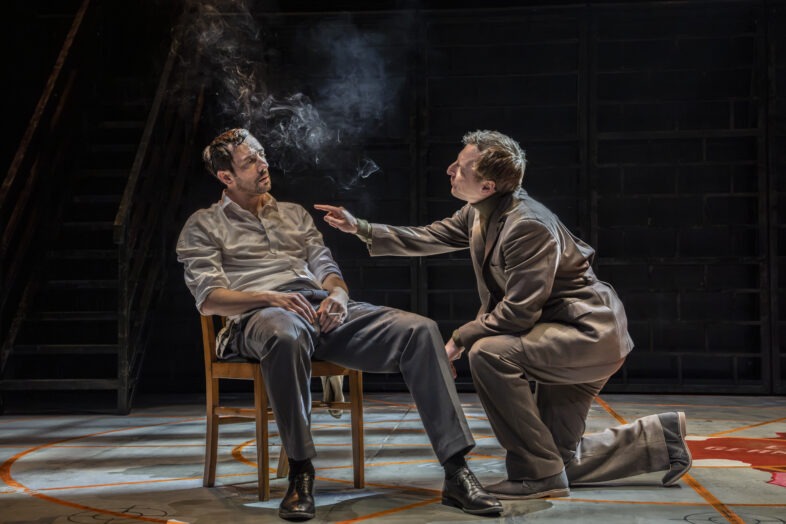
The cast did an excellent job with the material, and I especially enjoyed Ralf Little’s gripping performance as Alec Leamas, as well as Gráinne Dromgoole’s portrayal of the somewhat naïve and foolish Liz Gold. Peter Losasso was suitably sinister as the head of East German intelligence, Mundt, while Nicholas Murchie portrayed British Control with just the right amount of snobbish authority.
Although the story was sometimes difficult to follow, it remained intriguing throughout, and I found myself leaving my seat at the interval eager to discover where it would lead next, even if I was still somewhat confused. While I haven’t read the novel myself, the adaptation appears to remain faithful to the source material, so fans of the George Smiley series should appreciate seeing it brought to the stage. I do think that familiarity with the book would enhance the experience, as it would make the twists and turns of the story easier to follow.

Overall, The Spy Who Came In From The Cold is an intelligent and atmospheric production with outstanding performances, particularly from Ralf Little, and some excellent lighting and sound design. However, its dense, fast-moving plot and sparse sets make it a challenging watch for anyone unfamiliar with the novel, and it can feel rather bleak throughout, despite a few lighter moments of levity. While I admired much of what it was trying to achieve, I found it difficult to fully connect with the story. If you’re already a fan of John le Carré’s work, though, you’ll likely get much more from it than I did.
The Spy Who Came In From The Cold is at The Alexandra, Birmingham until Saturday before continuing its UK tour. The production runs for approximately 2 hours and 20 minutes, including an interval.


